

Hey I’m Ben. I build stuff with agents, even though I’m not technical. Here’s all the stuff I’m reading and tinkering with. If you want to start building or level up your ‘vibe-coding’ skills, join our community.
Hey folks,
I’ve been running my own AI agent for a while now. It reads my emails, checks my calendar, manages my projects, and runs on a Mac Mini in my house 24/7. I built the whole thing through a terminal — talking to a coding agent, not writing code myself.
It’s a bit janky, but it’s mine and it works. I love it.
I’m not the only one doing this. OpenClaw blew up because people realised that an always-on agent with access to your stuff is genuinely useful. There’s a wave of people building personal agents right now. And my guess is, if you’re not - you will have one this year.
That’s where Dreamer comes in (and no, it’s not an ad or investment - just a tool and team I have massive respect for).
David Singleton (former Stripe CTO + big Ben’s Bites fan!) and Hugo Barra built Android together. Now they’ve started Dreamer with designer Nicholas, 14 others and $50m in funding.
A simple pitch: if you can dream it, you can build it.
What is it?
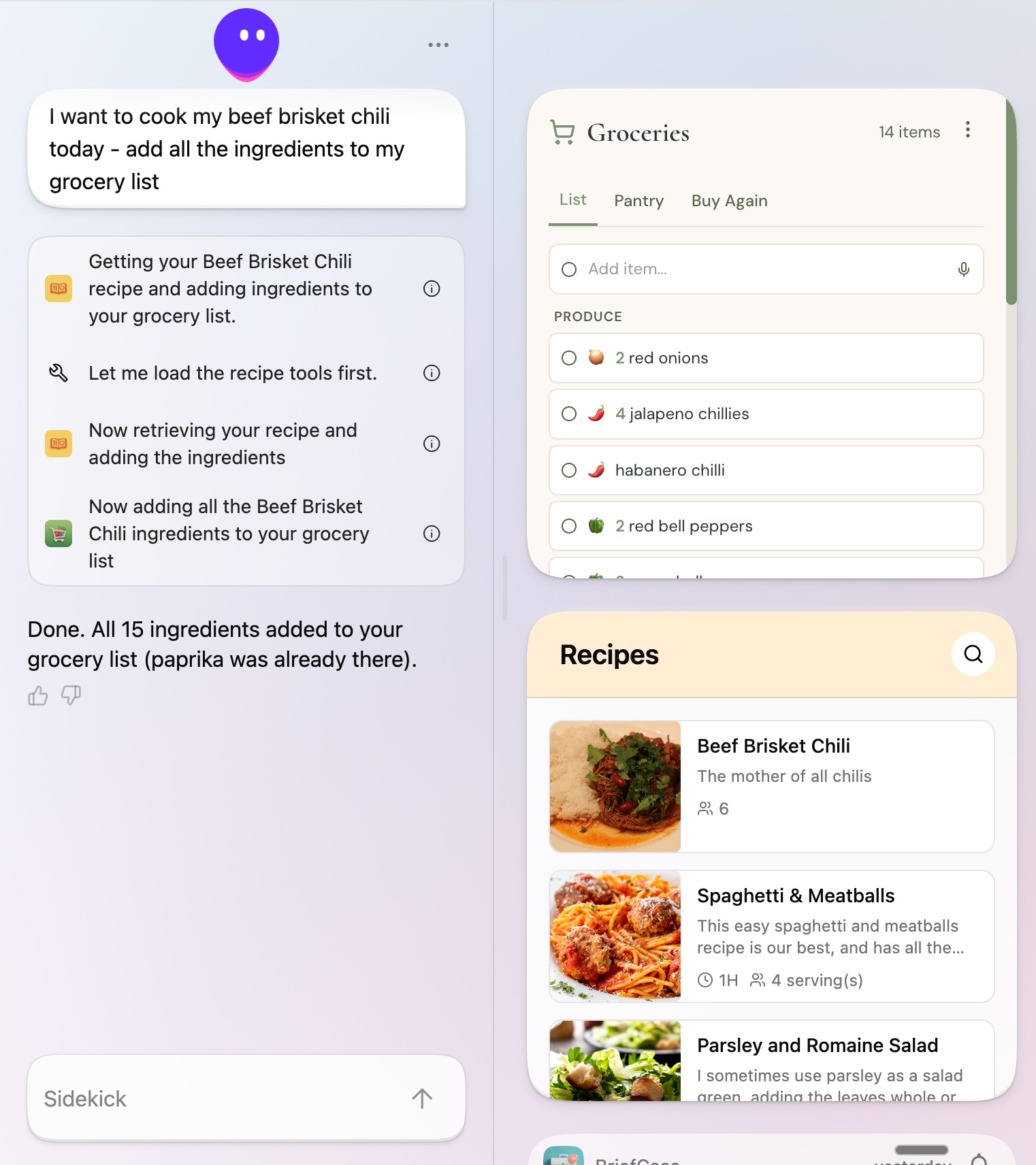
Dreamer is a platform where you build agentic apps by talking. You describe what you want, and an AI agent called “Sidekick” builds it for you in minutes. There’s also a more detailed coding agent for when you want to go deeper. Either way, you never think about hosting or deployment. The platform handles all of it.
That’s the bit I care about most. I spend a stupid amount of time on infrastructure. Getting servers running, keeping things alive, debugging why something crashed. That stuff is fine when you’re learning, but it’s not the point. The point is the thing you’re trying to make.
Sidekick learns about you over time and acts as the privacy layer, controlling what data each app in Dreamer can access. It can spin up temporary agents for specific tasks, integrate with third-party tools and coordinate between your different apps. All of that wiring is done for you out of the box.
What can you actually build?
Turns out, a lot:
pull together your work and personal calendars, then generate a daily briefing podcast.
saving links across the web (remember Pocket, rip) with summaries and tags
recipe manager that creates shopping lists and can order them from Instacart.
a to-do list that can research (and start!) tasks before you get to them
You describe what you want, Sidekick builds it, you iterate by talking. Build time is 6-10 minutes for moderate complexity. Once you’ve built something, you can share it in a gallery for others to use or remix.
There are loads of tools that help you build with AI right now — Claude Code, Cursor, Replit, Droid. But they’re still pretty technical.
Dreamer isn’t a coding tool. It’s not an IDE with AI bolted on. It’s a platform where the conversation is the input and the app is the output.
Live now
Dreamer had four months of closed alpha with strong engagement, and it's now moving to public beta today with a partnership with Anthropic.
2026 is the year of the personal agent, but right now it’s still a technical hurdle. Dreamer is the closest thing I’ve seen to making that accessible to everyone.
Read David’s deep-dive on how Dreamer works under the hood for the full story.
Now back to the top stories;
Peter Steinberger is joining OpenAI, and OpenClaw will become a foundation. He’ll work on bringing agents doing things and interacting with each other into OpenAI’s core products.
A bunch of new models released recently:
GPT-5.3-Codex Spark by OpenAI - 3x-5x faster than GPT-5.3-Codex. Think of it as a mini model (there are performance dips for that speed). It’s also a text-only model with just a 128k context window. Runs on Cerebras’ hardware and available for Pro ($200/mo) subs. See it in action in Pi.
Minimax M2.5 and GLM-5 - Two models from Chinese labs that are worth paying attention to. M2.5 scores similarly to Opus 4.5 in coding benchmarks, and GLM looks really good at tool calling—while both of them are wayyy cheaper than Opus or GPT models.
Gemini Deep Think 3 - Based on Gemini 3 Pro, scores 84.6% on ARC-AGI 2 (vs 68.8% from Opus 4.6), available for Gemini Ultra subscribers, and that’s… it. They say it’s coming soon to the API, but there aren’t many details to care about this model. It does score really well on academic tests compared to other models, though. And I think that’s what matters to Google/DeepMind here. Why?
Because OpenAI claims GPT-5.2 derived a new result in theoretical physics. GPT-5.2 simplified a complex formula to describe a particle’s behaviour. It’s not groundbreaking, but it is “new work”. OpenAI is also throwing their models at other hard problems in Math and testing how well they do at 1stproof.org (read more)
Why’s there always a meeting bot in your Zoom call? Blame Recall.ai. They power every meeting AI app, from Cluely to Hubspot to Clickup. Recall.ai handles the hard part: getting recording data across meeting platforms. Get started with $100 in credits.*
From the portfolio:
Factory’s co-founder, Eno Reyes, published a full tutorial on how to make AI apps with agents
Mirai raised $10M seed funding for building on-device inference infra for Apple Silicon (37% increase in generation speed). For the first time since the iPhone, parts of the software stack can evolve independently of platform vendors.
🌐 What I’m consuming
The vibe coding trap - Max makes the point that SaaS is not really dead. Easy to build doesn’t make software easy to own & maintain.
Andreas made a video with a similar angle (this is probably the single best source of my thinking atm too) - if oneshotting software is going to be (already is?) so normal, what should founders build? Paul Graham has an essay on this: “Taste for Makers” from 2002.
The ten moats of vertical software (and what LLMs do to each).
Demoing the AI computer that doesn’t yet exist - No apps, generative software, local inference, first-class voice input, and deep personalisation.
How system prompts define agent behaviour.
A running journal of getting real work done with OpenClaw.
Why I’m not worried about AI job loss, ordinary people will be fine.
Shifting structures in a software world dominated by AI.
Dario Amodei was on Dwarkesh’s podcast. They talk a lot about making money as a frontier lab, and why not just buy more GPUs if AGI is coming for sure.
Is it possible for AI agents to output polished boardroom-ready reports backed by real, fact-checked research? It is with Superagent. Give it a question, and it gets to work: Subagents interrogate your topic, scour credible sources, and package it all up into reports, slides, docs, or websites.*

⚙️ Tools and demos
Durable Endpoints by Inngest - Make your APIs unbreakable with just one line of code. No workers. No queues. No added infra.*
Research Agent by ListenLabs - Analyse data, quantify insights, and generate research deliverables from the 100s of interviews you’ve done.
Context repositories by Letta AI - Git based memory for coding agents.
Type.com - Your chat app to launch agents and work with them.
Claw Mart - AI personas built by agents, for agents.
Kimi Claw - Kimi AI has its own version of OpenClaw with skills, cloud storage and more, powered by Kimi K2.5 Thinking.
Playbooks.com - The Gumroad of agent skills. Buy and sell premium skills.
Airstore - Turn all your data into a filesystem for AI agents.
IronClaw - AI CRM, hosted locally on your Mac. Built on OpenClaw.
Agentic Wallets by Coinbase - Give your agent the autonomy to spend, earn or trade.
Trustclaw - OpenClaw with secure authentication and sandboxed executions.
Claude Code on Desktop can now connect to your other devices and work like it’s running on them.
Long-running agents are now available to Cursor Ultra, Team and Enterprise users.
🥣 Dev Dish
purl - curl-like CLI for making HTTP requests that require payment. built by stripe.
x-cli - CLI for X/Twitter with the new official pay-per-use API.
bun.cron(file, schedule, name) - Schedule a function to be called on a recurring interval on your machine.
Obsidian has a CLI now. Early access and feature parity with the app.
Markdown for Agents - Agents can now fetch the markdown version of websites running on Cloudflare. Though markdown.new works for any website on the internet.
Starter template to show how WebMCP lets agents interact with any website without ever seeing the UI.
Memory in OpenClaw is still unsolved. Supermemory has a plugin for it (i’m an investor). Other attempts include this hierarchy-based memory system and a port of Mastra AI’s observational memory into an extension for Pi.
Dockhand - Manage your containers across all machines.
🍦 Afters
Simile - AI simulation of society, populated by agents based on real humans. Like a flight simulator for human decisions.
CoworkPowers - Knowledge work superpowers that compound over time.
Manus AI is coming for OpenClaw with a new always-on agent functionality. (Maybe pissed peter didn’t choose meta over openai 😬)
Anthropic raised $30B in funding at a $380B post-money valuation. Their revenue run rate is $14B as of today (up from about $1B in Jan 2025).
This 3-minute video was made 100% with AI. Related: The last ~8 months of AI video improvement (after Veo 3) is coming live in the last few weeks, especially with SeedDance 2.0, the latest video generation model from ByteDance, creating almost believable spoofs of real movie scenes. Disney and others have already sent them a cease and desist.
Agents need more than a filesystem to run your company.
Engineers are becoming sorcerers - Lead Engineer for OpenAI’s API platform.
Enjoy this newsletter? Forward it to a friend.
That’s it for today. Feel free to comment and share your thoughts. 👋
Read about me and Ben’s Bites
📷 thumbnail by @keshavatearth
* sponsors who made this newsletter possible :)
Wanna partner with us for Q1?
We took this to the extreme. Built a fully autonomous trading desk, 6 AI agents, $1M portfolio, they communicate only via email. No human in the loop by design. We wanted to stress test whether agents actually work without oversight.
It's live if you're curious: platypi.empla.io
All this is very exciting but the idea of non-technical users creating AI agents that have access to all or most/much of their personal productivity and finance systems is downright scary. Check out Gary Marcus's Substack on this very topic: https://garymarcus.substack.com/p/openclaw-aka-moltbot-is-everywhere
This is a pretty dangerous bit of tech that's being put in the hands of users, some of whom are unaware of the potential downsides. I'm a former technologist and TBH it didn't occur to me at all - just got lucky to read Gary's Substack before getting into this myself.